
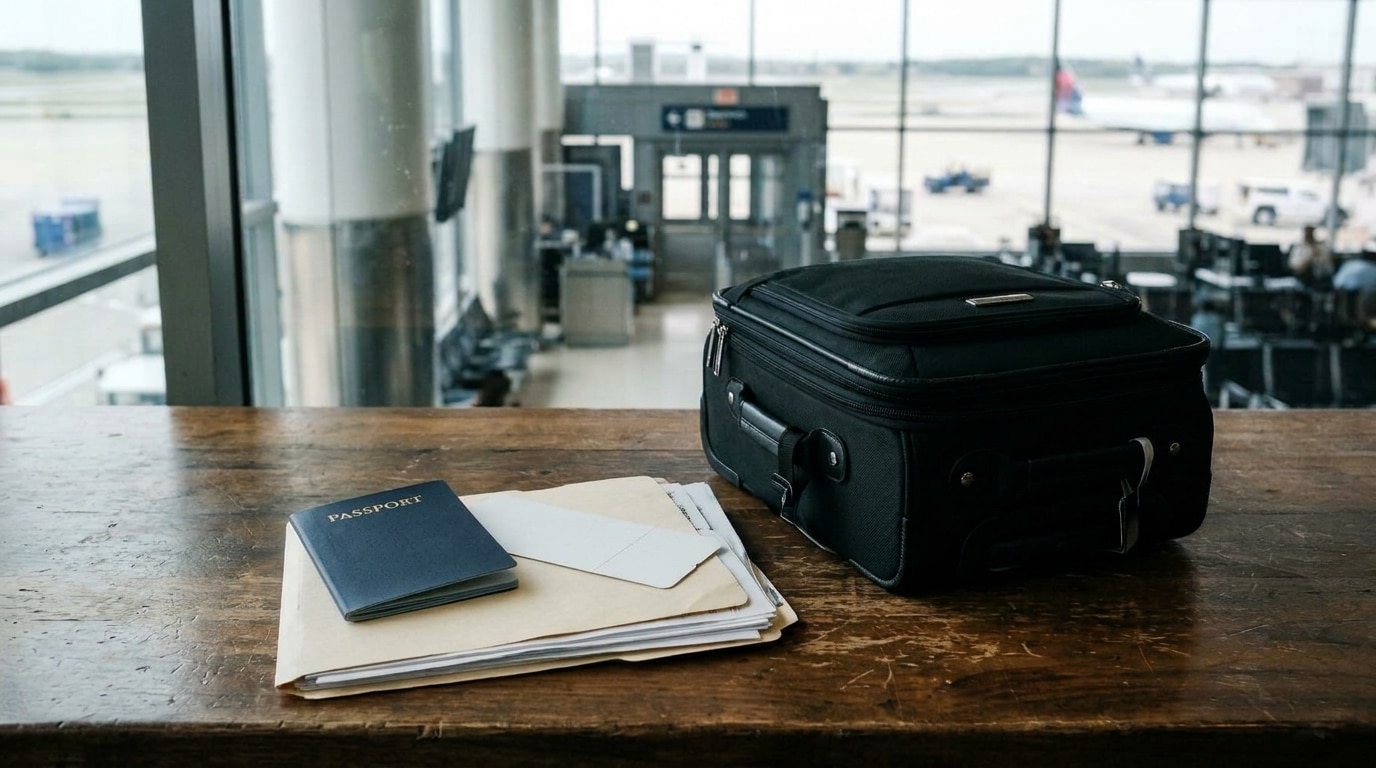
A family wedding abroad. A sick parent. A work trip you cannot refuse. Life does not pause just because your green card application is pending, and many applicants wonder whether a trip outside the United States is worth the risk.
The honest answer is that it depends on your situation, but for many applicants, leaving the country without the right travel document can end your green card case. A trip that feels harmless can lead to a denied application, a long separation from your family, or a bar from returning.
This guide explains what happens if you travel while your green card application is pending, how advance parole works, which applicants face the biggest risks, and what to do before you book a flight. If you live in Illinois or anywhere in the Chicago area, we also cover what to expect at O’Hare and how the local process fits in.
The Short Answer: Travel While Your Green Card Case Is Pending
If you filed for a green card from inside the United States, which is called adjustment of status (Form I-485), you should generally not leave the country until you have an approved advance parole document in hand. Without it, your departure may be treated as if you abandoned your application.
That rule has exceptions, which we cover below, and there are situations where the risk is much higher. Because a mistake can be very hard to undo, speak with an immigration attorney before you travel, even for an emergency.
What Does It Mean to Abandon Your Green Card Application?
Under federal regulations, when an adjustment applicant leaves the United States, the departure is generally treated as an abandonment of the application, unless the applicant was previously granted advance parole for that absence and is inspected on returning. You can read the rule in 8 CFR 245.2(a)(4)(ii).
In plain terms, USCIS can treat your case as closed because you left. The filing fees, the biometrics appointment, the months of waiting, and the work you put into your application may all be lost. If you are placed in removal proceedings, leaving the country is treated even more strictly.
This matters because a pending application is not a legal status. USCIS states in its Policy Manual that a pending adjustment application does not put an applicant in a lawful immigration status. Until your green card is approved, you are an applicant, not a permanent resident.
What Is Advance Parole?
Advance parole is a travel document that lets certain applicants leave the United States and return without abandoning a pending application. It is requested on Form I-131, and for people with a pending Form I-485, it is filed as a “Type D” request, as described on the USCIS Form I-131 page.
A few points are worth knowing:
- Timing. USCIS says that if you depart without an advance parole document that is valid for the entire time you are abroad, your Form I-131 will be treated as abandoned. The document must be approved before you go, and it must cover your whole trip.
- Proof. To apply from inside the United States, you generally provide a copy of your USCIS receipt showing that you filed the adjustment application, along with identification, photos, and evidence of the reason for your trip.
- Fees. Filing fees change over time, so check the current fee on USCIS before you file.
- Passport. Advance parole does not replace your passport. You still need a valid passport from your country to travel.
Many applicants file the travel document request at the same time as the green card application, or soon after. Processing can take time, so waiting until a week before a trip is rarely a good plan.
Advance Parole Does Not Guarantee That You Can Come Back
Even with an approved advance parole document, you are not guaranteed reentry. USCIS states that advance parole does not guarantee that you will be allowed back into the United States, and that a U.S. Customs and Border Protection officer makes the final decision at the border.
Officers can ask about your immigration history, your reason for the trip, and anything in your record that may cause concern. Having your documents organized and being honest and consistent matters a great deal.
There is another risk if your case is denied after you travel. Under the same regulation, an applicant who traveled on advance parole and whose application is later denied may be treated as an applicant for admission, which can leave you without a way to stay.
Who Faces the Biggest Risks When Traveling?
Some applicants are in a much more fragile position than others. Take extra care if any of these apply to you:
- You overstayed a visa. Time spent in the United States after your authorized stay ended can count as unlawful presence, and leaving can trigger a 3-year or 10-year bar. Our guide to marrying a U.S. citizen after a visa overstay explains how these bars work.
- You entered without inspection. If you crossed the border without being inspected, your options for adjusting status are very limited, and leaving the country can create serious problems.
- You have a criminal record. Arrests and convictions, including some that seem minor, can affect your admissibility. Read our guide on whether you can be deported for a DUI.
- You are in removal proceedings. Leaving the country while in proceedings is treated as an abandonment of the application, and you should not travel without legal advice. Our guide on what to do if you receive a Notice to Appear explains your first steps.
- You have had a prior removal order or prior unlawful presence. These can lead to separate bars that advance parole does not erase.
The USCIS travel documents page warns that anyone who has been in the United States unlawfully may face a bar to admission under section 212(a)(9) of the Immigration and Nationality Act, even with a travel document. That is why your full history has to be reviewed before you leave.
Exceptions for Some Work Visa Holders
The regulations contain exceptions for some applicants who remain in a valid nonimmigrant status. For example, an adjustment applicant who is in lawful H-1 or L-1 status may be able to travel without abandoning the application, as long as they remain eligible for that status on return and resume work with the same employer. Similar rules apply to dependents in H-4 and L-2 status, and to certain K-3, K-4, and V categories.
These exceptions come with specific conditions, and they only help people who are actually maintaining that status. Do not assume that you qualify. Have an attorney review your visa, your employer, and your travel plans before you book.
What About Marriage-Based Applicants?
If you applied for a green card through marriage, your spouse’s petition (Form I-130) and your adjustment application are usually reviewed together before your interview. Our guides on the marriage green card timeline and I-130 processing times explain what to expect.
Travel during this period is a frequent source of mistakes. A trip without advance parole can end the adjustment case even though the marriage is real and the petition is strong. It can also complicate your interview, which we describe in our guide to what happens at the green card interview.
What If Your Case Is Handled at a U.S. Consulate Abroad?
Some applicants do not file for adjustment of status. Instead, they go through consular processing, where the case is completed at a U.S. embassy or consulate. The rules about abandonment of an adjustment application do not apply the same way, because there is no pending adjustment application to abandon.
However, other issues can still matter, such as visa status, unlawful presence, and what is allowed under your current status. The right answer depends on how your case is filed, so confirm it with an attorney before you make travel plans.
Before You Book a Trip: A Checklist
If you are thinking about traveling while your application is pending, take these steps first:
- Confirm your case type. Know whether you filed for adjustment of status or are going through consular processing.
- Review your history. List every entry and exit, any overstay, any arrest, and any prior immigration application.
- Check for advance parole. Make sure you have an approved document and that it is valid for your entire time abroad.
- Check your passport. It should be valid for the full trip, with time to spare.
- Keep your documents together. Carry your receipt notices, advance parole document, and passport in your carry-on.
- Talk to an attorney. A short consultation before the trip costs far less than a denied case.
Traveling Through Chicago O’Hare and the Chicago Area
Many Illinois applicants return through Chicago O’Hare International Airport, where CBP officers inspect arriving travelers. If you are asked additional questions, stay calm, answer honestly, and carry the documents that support your case. For adjustment interviews, applicants in the Chicago area are typically scheduled through a local USCIS field office, so a well-prepared case matters even more if you have traveled.
How Sadjadi Law Helps Immigrants With Travel Questions During a Green Card Case
At The Law Offices of Shirley Sadjadi, P.C., we help applicants understand the risks of travel before they leave. Our entire staff is fluent in both English and Spanish, so nothing gets lost in translation when your status and your family are on the line.
We focus on reviewing your full history first, because the right travel decision depends on details such as your entry, any overstay, and your current status.
Our services for applicants with pending green card cases include:
- Travel risk review: Examining your case, history, and travel plans to explain the risks before you book.
- Advance parole guidance: Advising whether you need an advance parole document and how to apply.
- Green card filing support: Helping you file and manage your adjustment of status case.
- Interview preparation: Helping you prepare confidently for your green card interview.
- Removal defense: Representing clients in immigration court when a case involves removal proceedings.
Contact The Law Offices of Shirley Sadjadi to schedule your consultation.
Frequently Asked Questions
| Question | Answer |
| Can I leave the U.S. while my green card application is pending? | It is risky. For most adjustment applicants, leaving without an approved advance parole document may be treated as abandoning the application. Some exceptions exist, such as for certain H-1 and L-1 workers, so talk to an attorney first. |
| What is advance parole? | Advance parole is a travel document, requested on Form I-131, that lets certain applicants leave and return without abandoning a pending application. It must be approved before you leave and valid for the entire time you are abroad. |
| Does advance parole guarantee I can come back? | No. USCIS says a CBP officer makes the final decision at the border. Your history, including any unlawful presence, can still cause problems. |
| Can I travel if I overstayed my visa? | Be very careful. Leaving after accruing unlawful presence can trigger a 3-year or 10-year bar. Speak with an immigration attorney before you travel. |
| Is my work permit enough to travel? | No. A work permit (EAD) allows you to work, not to return after leaving. Advance parole is a separate travel document. |
| What happens if my application is denied after I travel on advance parole? | You may be treated as an applicant for admission, which can limit your options. This is why a careful review of your case is important before traveling. |
| Do I need a lawyer before traveling with a pending green card case? | It is strongly recommended. A mistake with travel can end a case or create a bar, and these problems can be hard to fix. |