
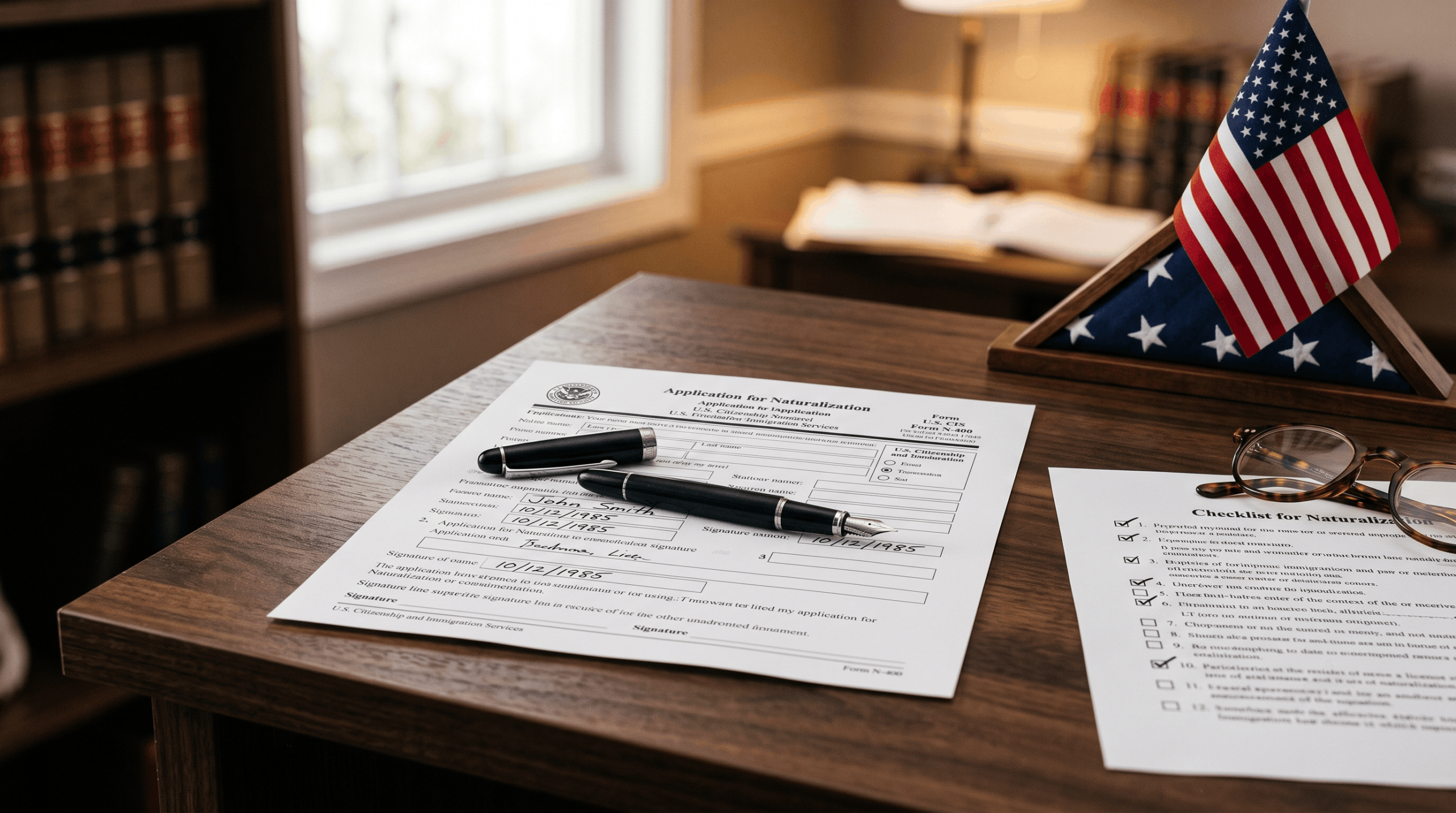
To become a U.S. citizen through naturalization, you must generally be at least 18 years old, have held a green card for five years (or three years if married to a U.S. citizen), and demonstrate continuous residence and physical presence in the United States. Additionally, you must show good moral character, pass an English and civics test, and swear an oath of allegiance to the U.S. Constitution. If you meet these core U.S. citizenship requirements, you may be eligible to file Form N-400 and start your journey to citizenship.
While the naturalization requirements might sound straightforward in a list, proving them to U.S. Citizenship and Immigration Services (USCIS) requires careful attention to detail. Every day you spend outside the country, every past interaction with law enforcement, and your overall timeline as a lawful permanent resident will be scrutinized. For many people, understanding exactly what counts as “continuous residence” or “good moral character” is the most confusing part of the process.
Do not let the complexity of the immigration system discourage you. This article will break down the eligibility for naturalization step by step so you know exactly what is expected of you. By understanding the rules before you apply, you can avoid common pitfalls, determine if you qualify for any special exemptions, and prepare a strong application to finally secure your American citizenship.
Basic US Citizenship Requirements for Naturalization
Before you submit your application, you must ensure you meet all the US citizenship requirements set by law. The government applies these standards strictly.
| Requirement | What It Means / Details |
| Age and Status | Must be at least 18 years old and a lawful permanent resident (have a valid green card). |
| Time as Resident | Must have held your green card for at least 5 years (or 3 years if married to a U.S. citizen). |
| Continuous Residence | Must not have taken trips outside the U.S. lasting 6 months or longer during the statutory period. |
| Physical Presence | Must have been physically inside the U.S. for at least half of your required residency period (e.g., 30 months out of 5 years). |
| Good Moral Character | Must have a clean criminal record and show adherence to community standards, including paying taxes and child support. |
| English & Civics | Must be able to read, write, and speak basic English, and pass a test on U.S. history and government. |
| Attachment to Constitution | Must support the U.S. Constitution and be willing to take the Oath of Allegiance. |
Age and green card status (must be at least 18 and a lawful permanent resident)
The most fundamental requirements to file your application include:
- At least 18 years old at the time you file.
- A lawful permanent resident (LPR) with a valid green card obtained legally.
If you acquired your green card through fraud or a mistake, USCIS can deny your citizenship and even place you in removal proceedings.
The 5-year rule (and the 3-year rule for spouses of U.S. citizens)
The amount of time you must wait before applying depends on your situation:
- General 5-year rule: You must have held a green card for at least 5 full years. The clock starts on the “Resident Since” date on your green card.
- 3-year rule (spouses of U.S. citizens): If you are married to and living with a U.S. citizen who has been a citizen for at least 3 years, you may apply after 3 years as a permanent resident.
Continuous residence
You must have continuously resided in the United States as a green card holder for the required five years (or three years). Continuous residence means you have maintained the U.S. as your primary home. Taking short vacations abroad is fine, but long absences can disrupt this requirement:
- Trips longer than 6 months may disrupt continuous residence and can restart your clock.
- Trips of 1 year or more will completely break continuous residence.
Physical presence
While continuous residence focuses on how long you were away on any single trip, the physical presence requirement focuses on the total, cumulative number of days you were actually inside the United States:
- 5-year applicants: Must have at least 30 months of physical presence in the U.S.
- 3-year (spouse) applicants: Must have at least 18 months of physical presence.
You must count every single day you spent abroad on any trip and subtract it from your total time to ensure you meet this standard.
Good moral character
USCIS requires all applicants to demonstrate “good moral character” during their statutory period (the five or three years before applying). Having good moral character generally means you have followed the law and met your civic responsibilities.
This requirement goes beyond just avoiding criminal convictions. You must show that you meet standards such as:
- Paying your taxes on time or maintaining an active payment plan with the IRS.
- Supporting your dependents, which includes paying any court-ordered alimony or child support.
- Telling the truth to immigration officials during all past and current applications.
English and civics knowledge
Unless you qualify for an age or medical exemption, you must demonstrate a basic understanding of the English language, including the ability to read, write, and speak it. During your interview, the USCIS officer will evaluate your spoken English and ask you to read and write a simple sentence.
You must also pass a civics test to show your knowledge of U.S. history and government. The version of the civics test you take depends on when you file your application.
If you filed your Form N-400 on or after October 20, 2025, you will take the updated version of the test, which is drawn from a bank of 128 questions. The officer will ask you up to 20 questions, and you must answer 12 correctly to pass.
If you filed your application before October 20, 2025, you will take the older version of the test, where you are asked up to 10 questions from a bank of 100 and must answer 6 correctly.
Attachment to the U.S. Constitution
Finally, you must demonstrate that you are attached to the principles of the U.S. Constitution and well-disposed to the good order and happiness of the United States.
Practically, this means you must be willing to support and defend the country and take the Oath of Allegiance at a public ceremony.
U.S. Citizenship Requirements That Can Disqualify You
Meeting the green card to citizenship requirements is only part of the process. You must also ensure you do not have any issues in your background that make you ineligible. If you are wondering what disqualifies you from U.S. citizenship, the most common reasons include:
- Serious criminal convictions: Crimes such as murder or “aggravated felonies” permanently bar you, while theft, fraud, or domestic violence can temporarily prevent you from proving good moral character.
- Tax problems: Failing to file your income taxes or pay what you owe the IRS is a major red flag.
- Unpaid child support: If you owe back child support, your application will likely be denied.
- False claims to citizenship: Registering to vote or claiming to be a U.S. citizen before you actually are is a severe violation.
- Lying to immigration officials: Providing false information or hiding facts during your immigration journey can result in denial and even deportation.
Special Cases and Exceptions
The standard US citizenship requirements do not apply equally to everyone. There are several special cases and exceptions that make the process easier for certain groups:
- Military service: If you serve honorably in the U.S. armed forces during a designated period of hostilities, you may be eligible to apply for naturalization immediately, skipping the required years of permanent residence.
- The 50/20 rule: If you are at least 50 years old and have been a green card holder for 20 years, you are exempt from the English language requirement and can take the civics test in your native language.
- The 55/15 rule: If you are at least 55 years old and have been a green card holder for 15 years, you are also exempt from the English language requirement and can take the civics test in your native language.
- The 65/20 simpler civics test: Applicants who are 65 or older with 20 years of permanent residence take a much simpler version of the civics test (along with the native language exemption).
How to Apply Once You Meet the Requirements
Once you are confident that you meet all the eligibility criteria, the process of applying is straightforward. The general naturalization process involves these steps:
- File Form N-400: Submit your Application for Naturalization, along with the required filing fee and supporting documents (such as a copy of your green card).
- Attend the biometrics appointment: USCIS will schedule you for an appointment where your fingerprints and photograph will be taken for a background check.
- Attend the naturalization interview and take the tests: You will take your English and civics tests, and a USCIS officer will review your application under oath.
- Attend the oath ceremony and receive your Certificate of Naturalization: If approved, the final step is to attend a naturalization ceremony to take the Oath of Allegiance.
Talk to an Immigration Attorney in Elgin, IL
Figuring out if you meet all the U.S. citizenship requirements can be challenging. This is especially true if you travel frequently, have had past legal issues, or owe back taxes. Before you submit your application and pay the filing fees, it is always best to have an immigration attorney review your case to ensure there are no hidden red flags that could result in a denial.
At the Law Offices of Shirley Sadjadi, P.C. in Elgin, Illinois, we are passionate about helping permanent residents achieve their dream of becoming U.S. citizens. We can help you evaluate your timeline, gather the necessary evidence, and prepare you for your interview. Our entire staff is fluent in both Spanish and English, so you can communicate comfortably in the language you prefer.
Call us today at 847-595-5338 to schedule a free consultation. Let our experienced immigration team guide you through the naturalization process from start to finish.
Frequently Asked Questions
| Question | Answer |
|---|---|
| How long do I have to have a green card before applying for citizenship? | In most cases, you must have been a lawful permanent resident for at least five years before you can apply for naturalization. However, if you are married to and living with a U.S. citizen, you may be eligible to apply after just three years as a permanent resident. |
| Can I apply for citizenship after 3 years of marriage? | Yes, if you are married to a U.S. citizen, you can apply for citizenship after three years of holding a green card. However, you must have been married to the same U.S. citizen for the entire three years, and your spouse must have been a U.S. citizen for those three years as well. |
| What disqualifies you from U.S. citizenship? | You can be disqualified from citizenship for failing to meet the continuous residence or physical presence requirements, or for lacking good moral character. Common disqualifiers include having a serious criminal conviction, failing to pay your taxes or child support, lying to an immigration officer, or falsely claiming to be a U.S. citizen. |
| Do I need to speak English to become a U.S. citizen? | Yes, a basic understanding of English is generally required. You must be able to speak, read, and write simple sentences in English to pass the naturalization interview. However, there are exemptions to this rule for applicants with certain medical disabilities, as well as for older applicants who have held a green card for 15 or 20 years (the 50/20 and 55/15 rules). |